
Stay Moving: Change Postures to Stay Comfortable
Stay Moving: Change Postures to Stay Comfortable
Nov 06, 2025
We don’t get stiff from one bad sitting moment; we get stiff from staying still too long. The best way to stay comfy and productive is to keep changing position. Small movements help your joints, refresh your muscles, improve focus, and reduce pain. Don’t chase one “perfect” posture — arrange your day and your workspace (chair, ergonomic desk, height-adjustable table) to make small, frequent shifts easy.
Here are a few tips to keep your body ergonomically healthy.
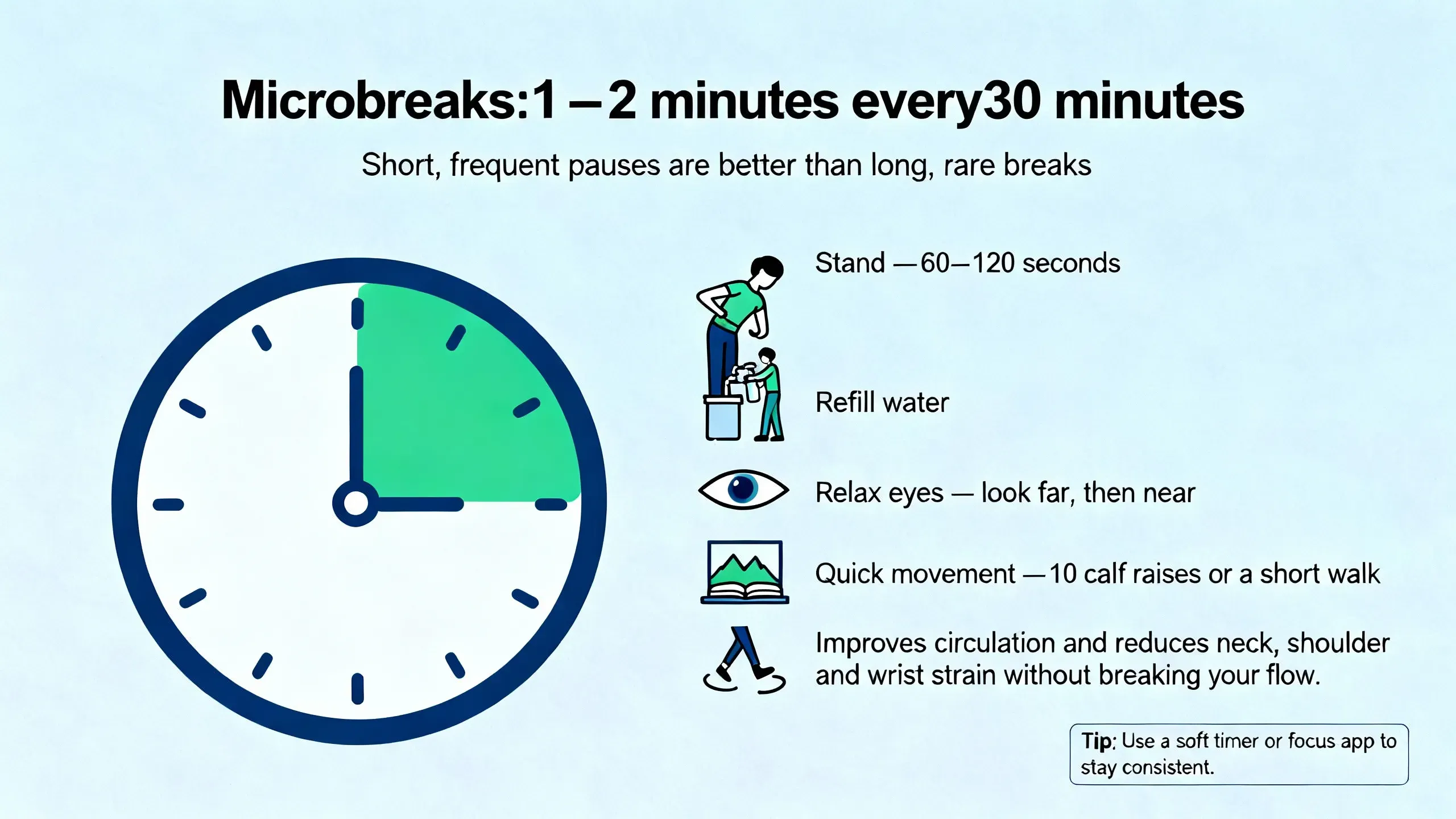 Microbreaks: 1–2 minutes every 30 minutes. Short, frequent pauses beat long, rare breaks. Every 30 minutes, stand for 60–120 seconds: refill water, look far and near to relax eyes, do 10 calf raises, or walk a small loop. These resets improve circulation and reduce neck, shoulder, and wrist load without breaking your flow. Use a soft timer or focus app to stay consistent.
Posture variety: Static loading is the real problem. Alternate an upright typing posture with a slight recline (10–15°) for reading or calls. If you have a height adjustable table, switch between sitting and standing two to four times daily. In standing, keep feet hip-width, knees soft, and alternate a foot on a small footrest. In sitting, set desk to relaxed elbow height, forearms parallel to the floor, and the monitor at arm’s length with eyes to the top third. Variety spreads load across tissues and maintains alertness.
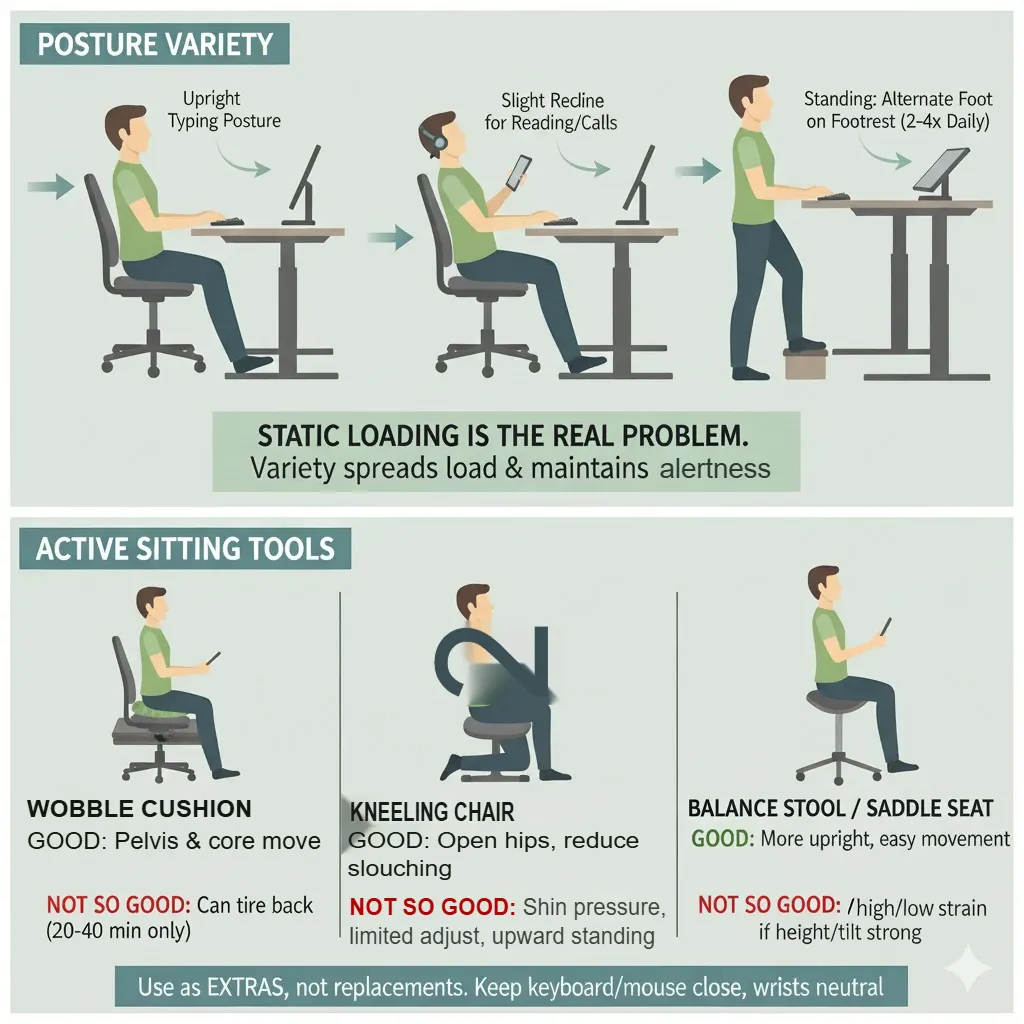
Active sitting: Active sitting tools can add gentle movement but should be used with care. Some active siting tools are wobble cushions, kneeling chairs
- Wobble cushions:
- Good: make your pelvis and core move a little, so you don’t stay stiff.
- Not so good: can tire your back if used all day. Try 20–40 minutes, then sit in a normal chair.
- Kneeling chairs:
- Good: open your hips and can reduce slouching, helping some people’s lower back.
- Not so good: put pressure on your shins, have limited adjustments, and make standing up often awkward. Best for short tasks or reading.
- Balance stools / saddle seats:
- Good: help you sit more upright and move easily.
- Not so good: can strain inner thigh muscles or lower back if the height or tilt is wrong.
Use these tools as extras, not full replacements for a good chair. Try different options during the week, keep keyboard and mouse close, and keep your wrists neutral.
Simple desk stretches: Do a few easy stretches during the day to loosen stiffness from sitting and screen time. Keep them gentle and do during your short breaks.
- Neck glides: Slowly slide your head straight back (like a soft double chin). Hold for 3 seconds, do 5–8 times. Helps reduce forward head.
- Scapular retractions: Pull your shoulder blades back and slightly down. Hold for 3 seconds, do 10 times. Helps your mid-back and posture.
- Hip flexor stretch: Stand with one foot forward and one back. Tuck your pelvis a little and hold for 20–30 seconds on each side. Good after long sitting.
- Wrist extensions: Keep one arm straight, palm down. Gently pull the fingers back with the other hand for 15–20 seconds each side. Relieves keyboard/mouse tightness.
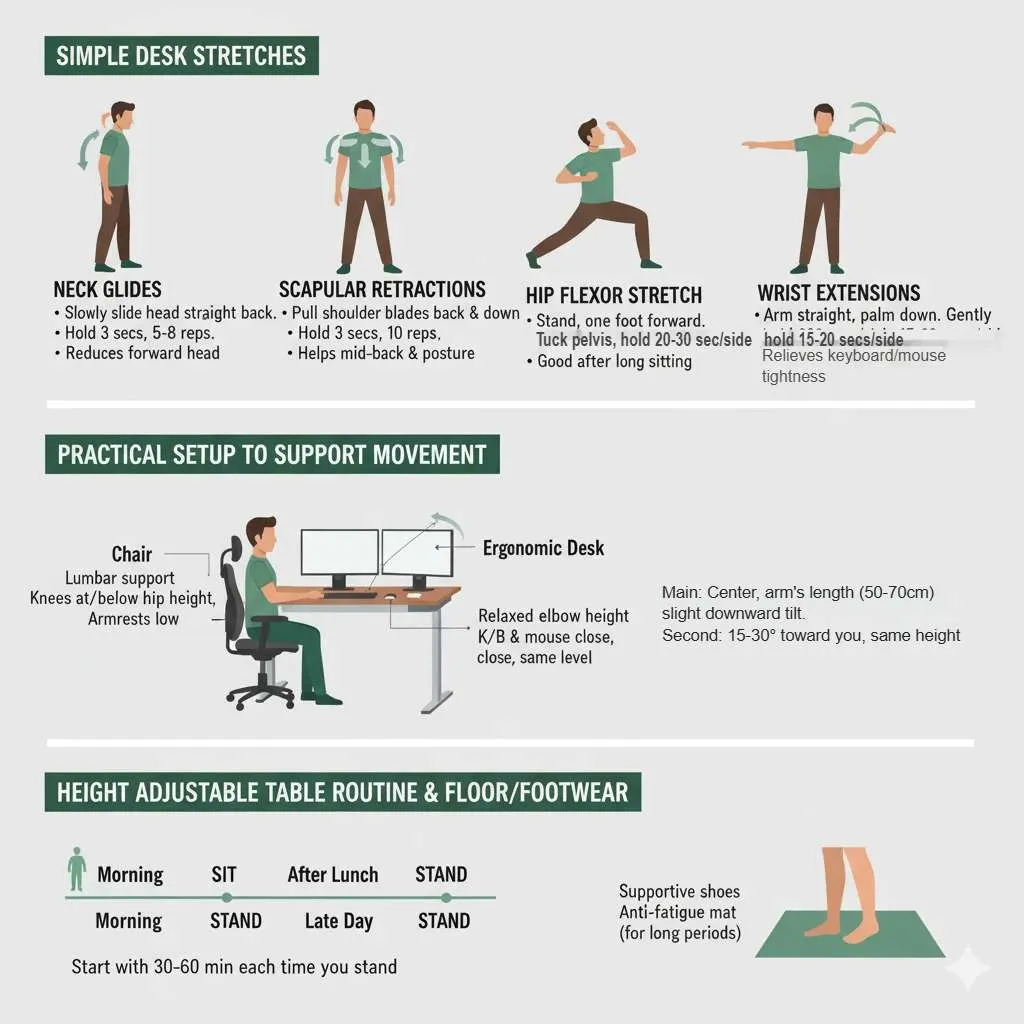
Practical setup to support movement.
- Chair: Use lumbar support. Set the seat so your knees are at or a little below hip height. Keep armrests low so your shoulders don’t lift.
- Ergonomic desk: Set the desk to your relaxed elbow height. Keep the keyboard and mouse close and on the same level.
- Monitors: Put the main monitor in the center, about an arm’s length (50–70 cm) away, with a slight downward tilt. Your eyes should meet the top third of the screen. Angle the second monitor 15–30° toward you at the same height.
- Height adjustable table routine: Sit in the morning, stand mid-morning, sit after lunch, and stand late in the day. Start with 30–60 minutes each time you stand.
- Floor/footwear: Wear supportive shoes. Use an anti-fatigue mat if you stand for longer periods.
Workday rhythm example
- 9:00–9:30: Sit upright and type with focus.
- 9:30: Take a short break; do neck glides and wrist stretches.
- 9:30–10:00: Lean back a little for reading; do shoulder blade squeezes.
- 10:00–10:45: Stand at the height adjustable table; switch one foot on a footrest.
- 10:45: Take a short break; do the hip flexor stretch. Repeat a similar routine in the afternoon.
Bottom line: the next posture is the best posture. Build a routine of microbreaks, posture variety, and simple stretches, and let your ergonomic desk and height adjustable table make movement effortless. You’ll feel less stiffness, more energy, and better focus—all within the same workday.